
PRINCIPLES
Most positivist research is fundamentally intended to unlock cause-effect relationships. Logically, cause and effect can be viewed in terms of three elements as shown in the following figure: an initial condition, a rule specifying the causal relationship, and an outcome.
For example, consider this simple example. We know that rain makes things wet (This is our RULE). So, if it is raining (our INITIAL CONDITION), then we can expect the road to get wet (our OUTCOME).

Given any two of these three elements, one can attempt to derive the third by a logical reasoning process. Given that there are
INDUCTION
The first logical method is INDUCTION. If we observe that every time it rains, the road gets wet, we can draw the conclusion that Rain makes things wet. In other words, given the initial conditions and the outcome, we can induce the rule.

DEDUCTION
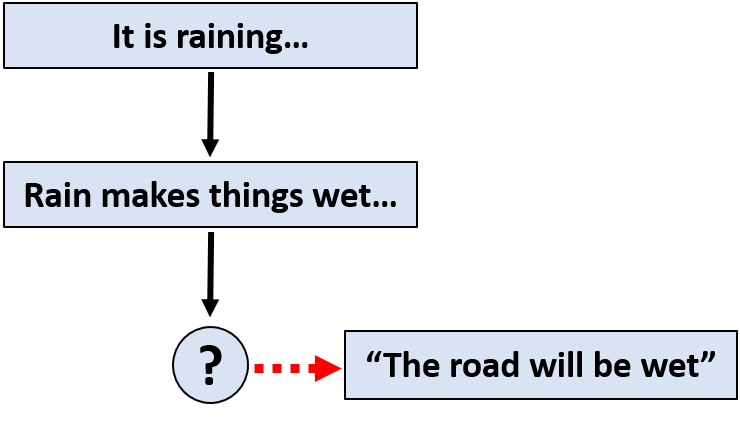
The second logical method is DEDUCTION. If we observe that It is raining, and we know that Rain makes things wet, then we can predict that The road will be wet. In other words, given the initial conditions and the rule we can deduce the outcome.
ABDUCTION
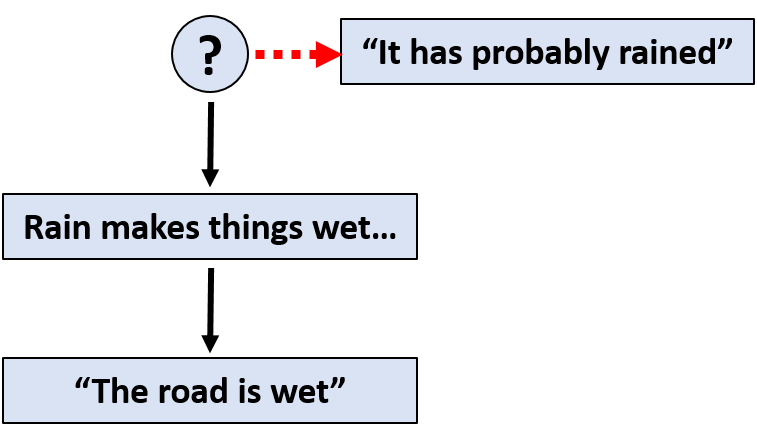
The third logical method is ABDUCTION. If we observe that The road is wet, and we know that Rain makes things wet, then we might infer that It has probably rained. In other words, given the outcome and the rule, we can abduce the initial conditions. Abduction is the most tentative and uncertain of the three logical approaches. In this example, that it has rained is not the only possible explanation for the road being wet. It may for example have been hosed down by a street cleaning machine, or there may be a burst water pipe.