

Induction and deduction are critical to science in general, and to biomedical science in particular. Medical science in particular frequently progresses as a result of the sequential application of inductive and deductive research. Here is an imaginary schema suggesting how medical scientists might have set about establishing a scientific basis for the practice of treating asthma with corticosteroids (anti-inflammatory agents derived from cortisone).
PHASE 1. INDUCTION
Doctors notice that patients with asthma appear to have an activated immune system. They note for instance that patients and their families have a history of allergy, and that blood results often show elevated levels of inflammatory markers, including IgE, which is typically associated with allergy. In addition to being discussed and reported informally, the possibility that asthma is associated with an activated immune system may be mentioned in case reports, case series, open articles and conference and seminar presentations. All of these may be seen as raising an interesting possibility, but do not constitute proof.

PHASE 2. DEDUCTION
Medical researchers now move the suggestion that asthma results from an activated immune system to from one based on unstructured observation to a hypothesis which they will test experimentally to provide scientifically valid evidence for the hypothesis or, alternatively, to provide evidence that the hypothesis is wrong.
Observational study
They may for instance study 100 asthmatics and 100 matched controls. They find that the observation is correct. Compared to the controls, the asthmatics have a statistically greater frequency of allergy, a family history of allergy, elevated IgE levels, etc. They postulate the hypothesis that asthma is associated with an activated immune system, and move to test it experimentally.
- (The initial condition) If patients have asthma…
- (The rule, here advanced as a hypothesis) And if it is true that asthma is caused by an activated immune system…
- (The outcome, here advanced as a prediction) Then we would expect that asthmatic patients differ significantly from healthy, matched controls in terms of levels of IgE, frequency of allergy, etc..
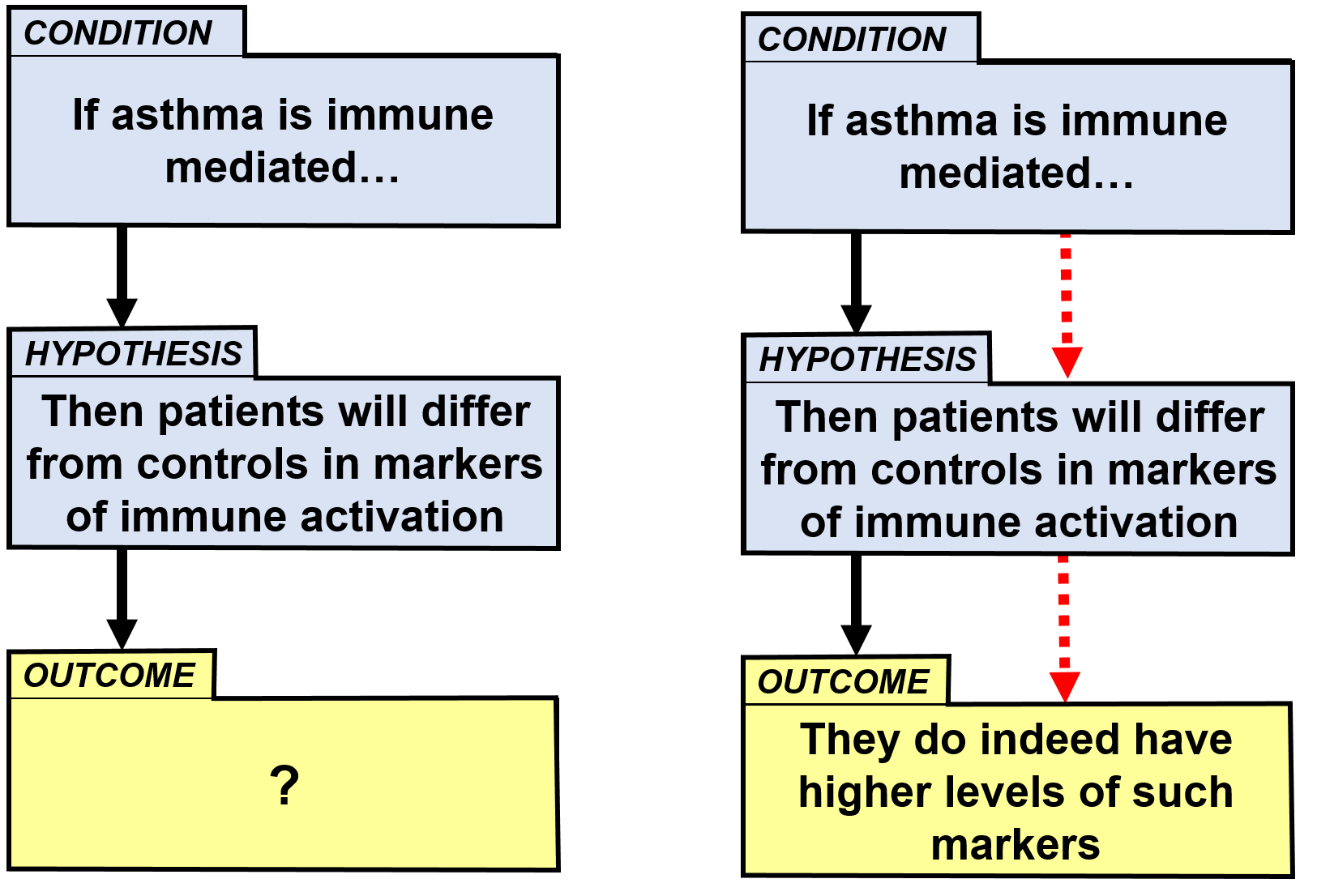
If they do indeed find that these markers occur with statistically greater frequency, or at statistically higher levels, than they do in controls, then they have provided evidence that the hypothesis may be true. If, on the other hand, there is no difference in markers, then this might suggest, in the absence of any other explanatory factor, that the hypothesis is incorrect, i.e. that the mechanism suggested on the basis of the inductive study is wrong.
Therapeutic trial
Having made the observation and having induced a rule (i.e. mechanism accounting for the link between asthma and the observations of allergy, family history and raised IgE levels, they now move to test the hypothesis. They now employ deduction, by performing an experimental study.
- (The initial condition) If patients have asthma…
- (The rule, here advanced as a hypothesis) And if it is true that asthma is caused by an upregulated immune system
- (The outcome, here advanced as a prediction) Then we would expect that treating patients with prednisone (a corticosteroid which downregulates immunity) would improve their asthma.
And so they devise and carry out an experiment, in the form of a clinical trial. They observe 200 asthmatics to establish a baseline for their pattern of asthma. Then they randomly assign 100 to a treatment arm, to receive prednisone, and 100 to a control arm, who receive a placebo. If the study outcome is as their hypothesis predicts (i.e. that treated patients will improve, while those receiving placebo do not), then this provides experimental support for their hypothesis.
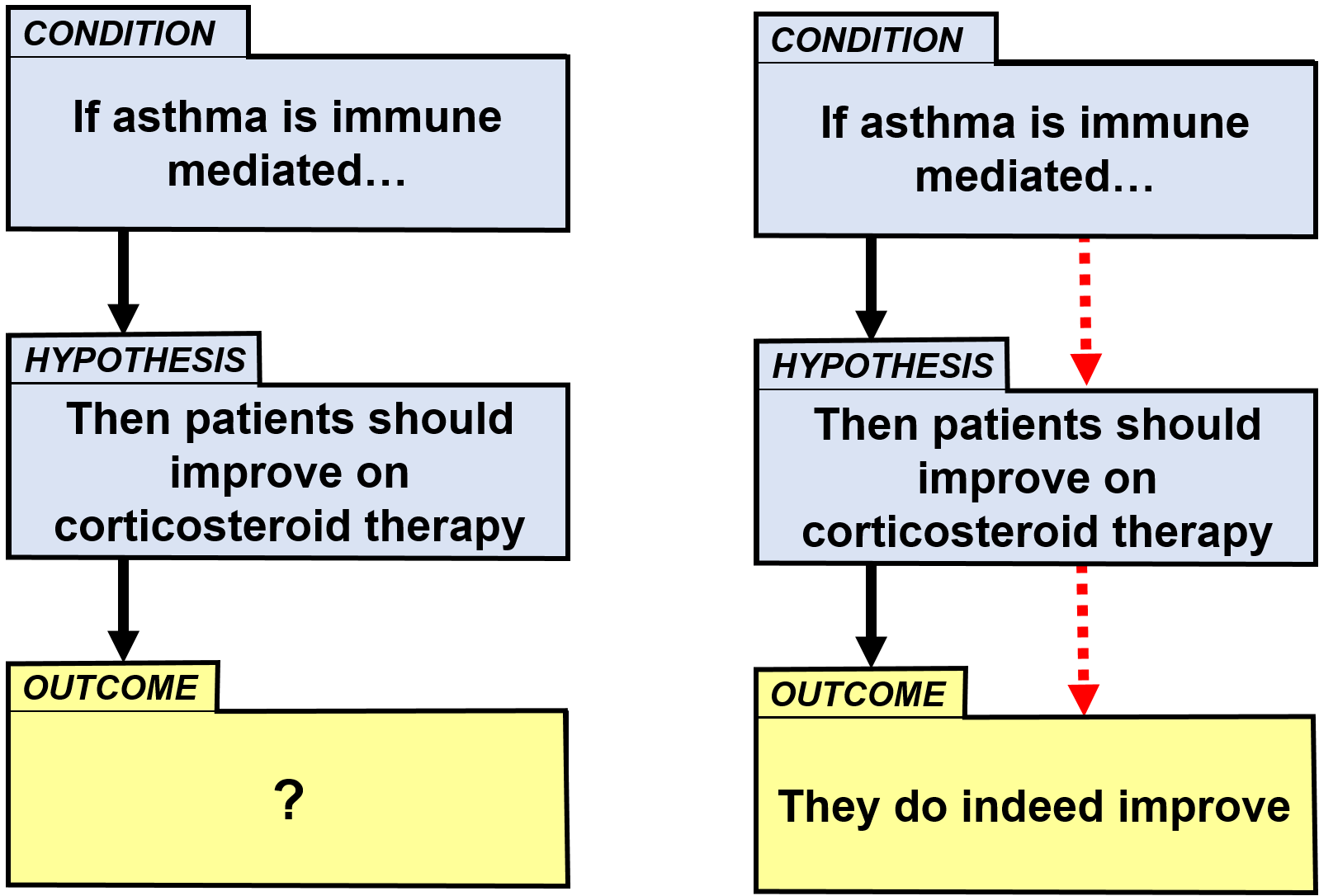
If, on the other hand, there is no difference in outcome, then this might suggest, in the absence of any other explanatory factor, that the hypothesis is incorrect, i.e. that the mechanism suggested on the basis of the inductive study is wrong.
WHAT DOES THIS MEAN FOR YOUR RESEARCH?
In our experience, it is common for people new to research, and particularly clinicians, to want to rush ahead and “set up a study”, and start working on a protocol for it. They may have some idea of a research topic, but this is often very vaguely conceptualised and formulated in their own heads. As you establish your research question, it is critical that you see which parts of your topic or research question requiring induction, and where you will apply the deductive logic. This will give you a very clear concept of how your move from observation to formulation of a hypothesis to seeking experimental proof of the hypothesis.
The the example on this page has given some insight into the experimental method which has underpinned scientific progress since the sixteenth century, from the time of Galileo to the present. It is possible to delineate the scientific method more precisely as laid out on the following page.
Next: The scientific method.